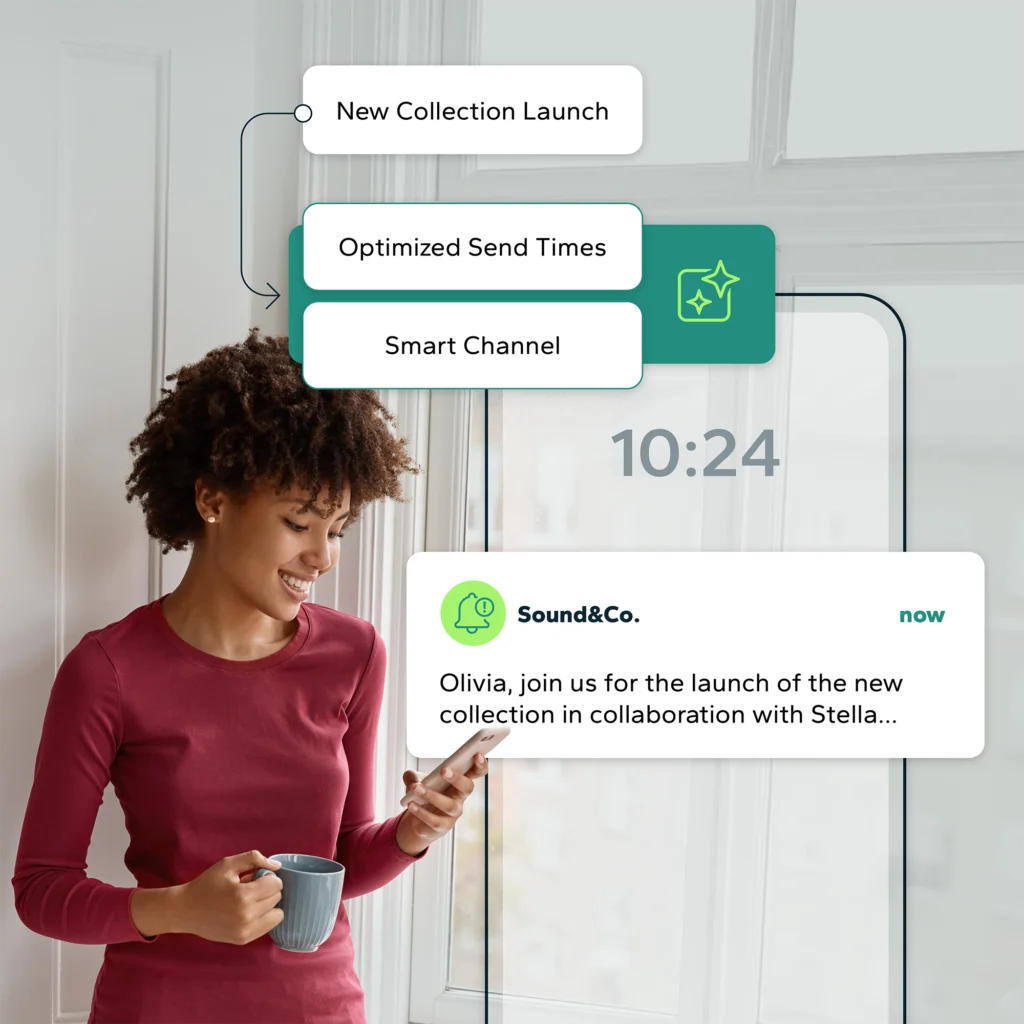
Consumers today interact with brands across a multitude of channels: email, SMS, mobile notifications, apps, social media, and websites. In this fragmented environment, companies can no longer simply multiply touchpoints. They must be able to synchronize them intelligently.
This is precisely the principle of omnichannel communication: delivering a seamless and consistent experience, regardless of the channel used.
To achieve this, marketing teams must orchestrate their communications strategically. Email, SMS, and notifications should not operate in silos, but rather act as complementary levers within the same customer journey.
When properly synchronized, these channels make it possible to send the right message, at the right time, through the right channel, according to each user’s behavior and context.
In this article, we will look at how to structure an effective omnichannel strategy by synchronizing email, SMS, and notifications in order to improve engagement, conversion, and customer experience.
Understanding the role of each channel in an omnichannel strategy
A high-performing omnichannel strategy first relies on a clear understanding of the role of each communication channel.
Not all channels serve the same function in the customer journey. Some are better suited to detailed information, while others are more effective for responsiveness or urgency.
Email: the preferred channel for content and relationship-building
Email marketing remains one of the pillars of digital communication.
It offers several important advantages:
- High content capacity
Unlike SMS or notifications, email allows for a wide variety of content to be included: detailed text, images, banners, call-to-action buttons, and even editorial sections. This richness of format enables brands to present a complete offer, explain a product, or share multiple pieces of information within a single message. Email therefore becomes a true marketing communication space where the company can develop its message in a structured way. - A space for brand storytelling
Brands can use email to tell a story, introduce a new collection, share editorial content, or highlight their expertise. This narrative dimension is essential for building a lasting relationship with subscribers. Unlike shorter channels, email makes it possible to explore a message in greater depth and create a stronger connection with the audience. - A loyalty-building tool
Newsletters, loyalty programs, and personalized communications are often delivered by email. This channel makes it possible to maintain a regular relationship with customers while offering content tailored to their interests. In an omnichannel strategy, email therefore often plays the role of the main channel for nurturing the customer relationship over the long term.
In an omnichannel strategy, email generally acts as the central channel around which other communications are structured.
SMS: a direct and immediate channel
SMS stands out for its extremely high open rate and its ability to capture attention quickly.
Its main strengths include:
- Near-instant visibility
Most SMS messages are read just a few minutes after they are received. Unlike email, which may remain unopened for several hours or even days, SMS immediately catches the user’s attention thanks to the notification on their phone. This speed makes it a particularly effective channel for urgent communications or messages with high time-sensitive value. - Short and effective communication
The SMS format imposes a character limit, which pushes brands to get straight to the point. This constraint can actually become a strategic advantage: the message is clear, direct, and easy to understand. A well-written SMS can quickly encourage the recipient to click a link, confirm an action, or take advantage of an offer. - An ideal tool for urgent communications
Limited-time promotions, appointment reminders, order confirmations, and important alerts are particularly well suited to SMS. In an omnichannel strategy, this channel often acts as an action accelerator.
SMS is therefore a powerful tool for strengthening the effectiveness of a marketing campaign or triggering a rapid response.
Notifications: a real-time engagement driver
Push notifications, whether mobile or web-based, offer the ability to interact with users immediately.
Their effectiveness is based on several factors:
- Contextual communication
Notifications can be triggered based on user behavior, for example after viewing a product or abandoning a cart. This contextual dimension makes it possible to send highly relevant messages at the moment when the user is most likely to interact. - A fast and discreet format
Notifications appear directly on the smartphone or computer screen. They are generally short and designed to quickly capture attention without fully interrupting the user’s activity. This format encourages quick interaction. - A strong capacity for personalization
Thanks to behavioral data, notifications can be tailored to the user’s profile, preferences, or interaction history with the brand. This personalization greatly enhances their relevance.
In an omnichannel strategy, notifications are often used to maintain engagement or rekindle a user’s interest at a specific moment in the customer journey.
Omnichannel orchestration: turning channels into a consistent experience
Having multiple communication channels is not enough to create a true omnichannel strategy.
The real challenge lies in orchestrating them intelligently.
Omnichannel orchestration consists of coordinating messages sent across different channels in order to create a consistent and seamless experience.
This involves, in particular:
- Avoiding redundant communications
When marketing teams work in silos, the same messages are often sent simultaneously across multiple channels. This can quickly create a sense of overload for the user. Omnichannel orchestration makes it possible to coordinate campaigns so that each message delivers specific value. - Maintaining consistency in messaging
Communications must follow the same narrative logic, whether they are sent by email, SMS, or notification. The tone, the offer, and the timing of delivery must remain consistent in order to create a seamless customer experience. - Adapting the channel to the customer’s context and behavior
Some messages are better suited to email, while others are more effective through SMS or notifications. An effective omnichannel strategy involves choosing the most relevant channel based on the situation and the user’s behavior.
For example, an omnichannel journey could work like this:
- An email introduces a promotional offer.
- An SMS is sent a few hours later to users who have not opened the email.
- A push notification reminds users of the offer if they have visited the product page.
Each channel is then used at the most relevant moment, without creating communication overload.
The timing of communications: a key performance factor
In an omnichannel strategy, timing is often just as important as the message itself.
Sending a communication too early or too late can significantly reduce its effectiveness.
Adapting the sending time to user behavior
Behavior analysis makes it possible to identify the most relevant moments to communicate.
For example :
- An email sent after sign-up
When a user subscribes to a newsletter or creates an account, a welcome email sent immediately helps confirm the registration, introduce the brand, and encourage the first interaction. - An SMS sent after cart abandonment
If a user adds a product to their cart without completing the purchase, an SMS can serve as a quick reminder. This type of message can include a direct link to the cart to make conversion easier. - A notification sent after product viewing
A push notification can remind the user about a recently viewed product or highlight a related promotion. This type of contextual communication increases the chances of conversion.
These interactions, triggered according to user actions, are often far more effective than mass campaigns.
Avoiding channel saturation
One of the risks of a poorly coordinated multichannel strategy is message overload.
A user who receives an email, an SMS, and a notification at the same time may quickly feel excessively solicited.
Good orchestration should therefore make it possible to:
- Prioritize certain channels
Not all communications require the same level of urgency. It may be preferable to use email first, then SMS only if no interaction has taken place. - Limit communication frequency
Defining marketing pressure rules helps avoid sending too many messages to the same user over a short period of time. - Adapt marketing pressure to the customer profile
Some users interact more frequently than others. A high-performing omnichannel strategy takes these differences into account in order to adjust communication frequency.
Behavior-based automation
Effective channel synchronization relies heavily on automation.
Modern marketing platforms make it possible to automatically trigger communications based on user behavior.
Behavioral triggers
Automated scenarios can be triggered by many signals:
- Newsletter sign-up
This moment is an excellent opportunity to engage the new subscriber immediately with a welcome email or a discovery offer. - Product page view
When a user visits a product page, it indicates potential interest. A personalized follow-up can encourage conversion. - Cart abandonment
Cart abandonment recovery campaigns are among the most effective in e-commerce. They remind the customer of the products left in their cart. - Interaction with a campaign
Clicking on a link or opening an email can trigger new communications tailored to the interest shown. - Prolonged inactivity
If a user no longer interacts with the brand for a certain period, a reactivation campaign can be triggered.
These triggers make it possible to create dynamic and highly personalized customer journeys.
Intelligent marketing journeys
Thanks to automation, companies can build scenarios such as:
- A welcome email after sign-up
This first message helps introduce the brand, confirm the registration, and encourage an initial interaction. - An SMS reminder if the email is not opened
If the recipient has not viewed the initial email, an SMS can serve as a quick reminder and increase the chances of engagement. - A notification to encourage purchase
A push notification can be sent at the right moment to encourage the user to complete their purchase.
This type of journey can significantly increase engagement and conversion.
How Dialog Insight facilitates omnichannel orchestration.
Implementing an effective omnichannel strategy requires a unified view of customer data and advanced orchestration capabilities.
This is precisely what a platform like Dialog Insight makes possible.
The platform offers several features that facilitate channel synchronization:
Centralization of customer data
Dialog Insight makes it possible to consolidate information from different touchpoints in order to obtain a complete view of the customer journey.
This data centralization makes it possible, in particular:
- To better understand user behavior
Interactions from multiple channels can be analyzed within the same environment. - To create more precise audience segments
Behavioral data makes it possible to identify different customer profiles. - To personalize communications
Messages can be tailored according to preferences and past interactions.
Omnichannel campaign orchestration
Marketing teams can coordinate their email, SMS, and notification campaigns within a single platform.
This makes it possible, in particular:
- To manage multiple channels simultaneously
Communications can be planned and triggered within the same environment. - To maintain consistency in messaging
Campaigns remain aligned with the overall communication strategy. - To avoid duplication or unnecessary communications
Orchestration rules help prevent sending multiple similar messages to the same user.
Customer journey automation
Thanks to automated scenarios, Dialog Insight makes it possible to trigger communications based on user behavior.
Companies can therefore:
- create personalized marketing journeys
- automate follow-ups
- adapt messages to the most relevant moment in the customer journey
Performance analysis and optimization
The platform also offers analytics tools to measure engagement across each channel.
Marketing teams can, in particular:
- analyze open and click-through rates
- compare channel performance
- optimize their omnichannel strategies
This analytical capability makes it possible to continuously improve campaigns..
Omnichannel as a driver of customer experience.
The multiplication of communication channels has profoundly transformed consumer expectations.
Today, users expect brands to be able to communicate in a fluid, consistent, and relevant way.
Synchronizing email, SMS, and notifications is not simply about using multiple channels. It is about orchestrating a true customer experience, where each interaction is part of an overall journey.
Thanks to a well-structured omnichannel strategy, companies can:
- improve engagement
- strengthen customer relationships
- increase conversions
And with platforms like Dialog Insight, marketing teams have the tools they need to orchestrate these communications in an intelligent and effective way.