
Centralize, structure and transform your customer data into actionable segments to create truly relevant communications.

For marketing teams who want to leverage their data without excessive technical dependence.
Gather your scattered data and transform it into a clear, structured, and ready-to-use database.
All your data sources are connected, harmonized and organized to allow you to better understand your customers and lay the foundations for more relevant marketing.
A solid foundation for understanding, segmenting, and activating your data.


Synchronize your tools and automatically centralize data from your different platforms.

Clean, harmonize and structure your data to make it understandable and easy to use.

Collect new data and enrich your customer profiles to better understand and personalize your communications.

Automatically aggregate your customer data from all your sources to create a unified, always up-to-date database.

Easily connect your tools (CRM, platforms, APIs) to eliminate silos and ensure smooth data flow.

Enhance your customer profiles with forms, surveys, contests and interactions directly integrated into your customer journeys.

Capture your customers’ actions and behaviors to better understand their journey and adapt your communications accordingly.

Organize your data into a clear and comprehensive view to quickly access relevant and actionable information.

Centralize and manage your customers’ communication preferences to stay compliant while building trust.
Centralizing your data is much more than simply grouping it. It’s about connecting, enriching, and structuring it to create a powerful marketing tool. These features allow you to build a reliable, scalable foundation ready to support your communications.
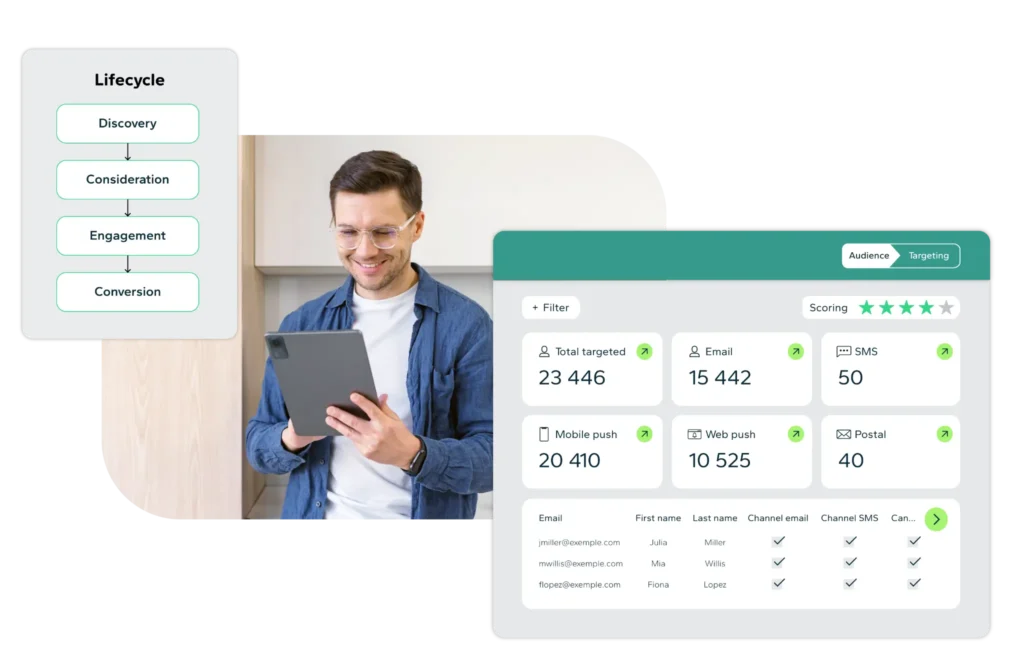
Use your data to create dynamic and targeted segments that can adapt to your customers’ behavior and support more relevant communications at every stage of the journey.

Analyze your customers’ behaviors, interactions, and journeys to create intelligent segments aligned with their reality and intentions.

Create dynamic segments and activate them easily to send the right messages, to the right people, at the right time.

Create segments that automatically evolve based on your customers’ behavior, data, and interactions.

Combine behavioral, transactional, and relational data to create accurate and truly actionable segments.

Identify your most engaged or high-potential contacts using scoring systems based on their actions and profile.

Understand where each customer is in their journey to adapt your communications at each stage.

Move quickly from analysis to action with segments that can be used directly in your marketing campaigns.
Use your segments across all your channels (email, SMS, push, web) to ensure consistency and maximize impact.
Transforming your data into useful segments is what allows you to take action. These features help you better understand your customers, target them precisely, and activate more relevant communications at the right time.

Isabelle Coutu
Head of Customer Experience and Digital Transformation

Dialog Insight consolidates your data from multiple sources (CRM, website, loyalty program, stores) into a single customer repository. There, you can view the timeline of each contact—their consents, messages received, and interactions—and create dynamic segments that can be applied directly to your campaigns, without having to export data or switch between multiple tools.
A CRM is generally used to track customer relationships, interactions, and information. A CDP, on the other hand, is used to unify data from multiple sources to create a customer view that can be used in marketing, particularly for segmentation, personalization, and campaign activation.
Activating customer data means using available information to create segments, personalize messages, and trigger relevant campaigns on the right channels, such as email, SMS, push, or RCS.

Dialog Insight’s marketing CDP helps you group, structure and activate customer data to create actionable profiles, dynamic segments and more relevant communications across marketing channels.
Customer data falls into two main categories: explicit data, voluntarily provided by the user, and implicit data, inferred from their behaviors. Understanding their complementary roles and knowing how to leverage them together makes it possible to personalize the experience, optimize marketing campaigns, and strengthen customer loyalty.
Customer data falls into two main categories: explicit data, voluntarily provided by the user, and implicit data, inferred from their behaviors. Understanding their complementary roles and knowing how to leverage them together makes it possible to personalize the experience, optimize marketing campaigns, and strengthen customer loyalty.
Find out how to make better use of your customer data.
